Papaw’s death
Hillbilly ElegyPapaw’s death turns an ordinary absence into a family rupture. When he misses the fixed appointments that had structured every day, J.D. Vance understands that something is wrong; within hours, Mom and Mamaw find him dead at home. The loss is personal, but its consequences reach beyond grief: it brings the family’s concealed crisis into view and permanently changes where J.D. lives.
The missed routine and discovery
Mamaw called to ask where Mom was and told J.D. that no one had seen or heard from Papaw. At first, he thought Mamaw was overreacting. Then he thought through Papaw’s exceptionally regular day. Papaw woke at six each morning without an alarm, went to McDonald’s at seven for coffee with former Armco colleagues, and afterward usually spent the morning at Mamaw’s house watching television or playing cards. Before dinner, he might stop at his friend Paul’s hardware store. He was also almost always at Mamaw’s when J.D. came home from school; if J.D. went instead to Mom’s, Papaw generally came by to say goodbye before going home. Missing all of those familiar occasions made his absence unmistakable.
Mom arrived a few minutes after Mamaw’s call and found J.D. already crying. He told her he thought Papaw was dead. The account of what happened next comes back to him in fragments: they picked up Mamaw and drove the few minutes to Papaw’s house. J.D. knocked violently at the front door while Mom ran around to the back. She saw her father hunched over in his chair, returned to the front, grabbed a rock, broke a window, and entered to tend to him. Papaw had been dead for nearly a day. Mom and Mamaw sobbed as they waited for an ambulance.
J.D. tried to comfort Mamaw, but at first she was so overwhelmed that she did not respond even to him. Once she stopped crying, she held him close and told him to say goodbye before Papaw’s body was taken away. J.D. went back to look at him, though he did not explain his real reason to the medical technician beside the body. The family then went to Aunt Wee’s house, where she met them in tears, before returning to Mamaw’s to make arrangements and contact relatives. J.D. was given the task of finding Lindsay Leigh Lewis. Before mobile phones, reaching his seventeen-year-old sister meant calling the house and her friends, none of whom answered. The adults discussed the funeral and where Papaw should be buried; Mamaw insisted on Jackson, Kentucky.
A family’s grief
Lindsay Leigh Lewis returned shortly before midnight. J.D. went down the street to tell her, and she stopped on the stairs when she saw his face. When he said Papaw was dead, she collapsed; he ran to her, and they held each other and cried. She had recently relied on Papaw to work on her car, and, through her tears, she worried that she had taken advantage of him. The memoir sets this regret against the distance that can exist between a teenager’s social life and an older relative who does not seem fashionable or easy to be around. Papaw wore the same old pocketed T-shirt, smelled of clothes left to dry in the washing machine, listened repeatedly to Johnny Cash, and drove an old El Camino. Yet he had worked on Lindsay’s car and, after she wrecked it, bought and fixed up another so she would not feel she came from nothing.
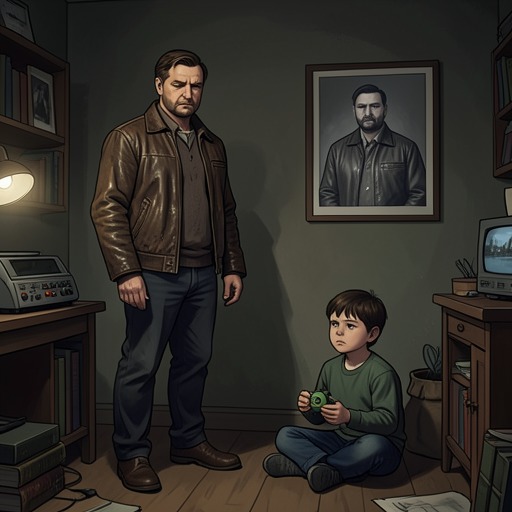
At the funeral, J.D. stood to explain what Papaw had been to him. He said that he had never had a dad, but Papaw had always been there and had taught him what men needed to know; he called him the best dad anyone could ask for. Papaw’s importance rested not only on practical care but on the kind of attention he gave his grandchildren. He practiced increasingly difficult math problems with J.D. and taught him that not knowing something was different from being unintelligent: knowledge could be gained through patience and hard work. He also got down on the floor to play with J.D. and Aunt Wee’s baby girls, and welcomed hugs and kisses despite his grouchiness. His example included a rule about how a man should treat the women in his family, a principle informed by his own earlier failures. After the funeral, people praised J.D.’s courage. Mom, however, seemed withdrawn and slow-moving, as if grief had overtaken her in a different way.
Grief exposes a hidden crisis
In the days after the funeral, the family’s responses diverged. Lindsay spent time with friends; J.D. stayed near Mamaw and read the Bible; Mom slept more and became increasingly angry at home. When Lindsay failed to do chores, Mom’s outbursts centered on the claim that her father had been the only person who understood her. J.D. initially took this as familiar temper rather than a sign that the household was approaching a crisis. Mamaw also kept him from staying at Mom’s, explaining that she needed him with her while she grieved. Lindsay, who had spent a night in J.D.’s room, promised that they would get through what was coming, though he did not yet know what she meant.
A few days after the funeral, J.D. saw Mom in a bath towel in her front yard, screaming at Matt, Lindsay Leigh Lewis, and her friend Tammy. A police cruiser was already there. When J.D. reached the porch and begged Mom to calm down, an officer grabbed her shoulders; she fell, struggled, and kicked as the officer carried her to the cruiser. There was blood on the porch, and someone said she had tried to cut her wrists. Mamaw took J.D. and Lindsay away. J.D. remembered thinking that Papaw would have known what to do.
Only in retrospect does J.D. connect this public breakdown to what had preceded it. A year earlier, Mom had lost her job at Middletown Regional Hospital after rollerblading through the emergency room. J.D. had understood her erratic behavior as a consequence of her divorce from Bob Hamel, while Mamaw’s remarks about Mom getting high seemed like offhand comments. Mom had begun taking prescription narcotics not long after the family moved to Preble County, Ohio. J.D. believes the use began with a legitimate prescription, but Mom soon stole drugs from patients and became so intoxicated that she rollerbladed through the emergency room. Papaw’s death did not begin the addiction; in J.D.’s account, it removed the last support that had allowed Mom to function at even a basic level.
The changed course of J.D.’s life
Before Papaw died, J.D. had a chaotic but workable arrangement: he divided his time between Mom’s home and Mamaw’s, and could retreat to one household when life in the other became difficult. After Papaw’s death, Mom went to the Cincinnati Center for Addiction Treatment, and J.D. began to feel like a burden to Mamaw. He understood that she had spent much of her life managing hardship, from poverty in the holler and Papaw’s abuse to Aunt Wee’s teenage marriage and Mom’s encounters with the law. Now she was raising two teenage grandchildren without Papaw’s help. Her public strength did not erase the grief and exhaustion J.D. had seen at the funeral home.
The death also stands within a longer sequence of disrupted homes. J.D. recalls the family leaving Middletown for Preble County during his third-grade year, returning to a duplex on McKinley Street after fourth grade, and moving again on the same street after fifth grade. By sixth grade, one of Mom’s partners had been replaced by another; by seventh, Matt was in the picture and Mom hoped J.D. would move with her to Dayton. After eighth grade came a brief stay with his biological father before J.D. agreed to move to Dayton; after ninth grade, he lived with Ken, a stranger, and Ken’s three children. Drugs, domestic violence proceedings, children’s services, and Papaw’s death compounded the instability. The memoir’s retrospective perspective makes the loss a turning point within this accumulated history, not an isolated misfortune.
After J.D. moved permanently into Mamaw’s house, the pattern changed. At the end of each of his tenth-, eleventh-, and twelfth-grade years, he still lived there with no one else. He later associated that continuity with being able to do homework, focus on school and a job, form lasting friendships, and clarify what he wanted from life. Most immediately, he remembered being happy: he no longer feared the end-of-day school bell, did not have to wonder where he would live the next month, and was no longer caught up in Mom’s romantic decisions. His grades improved, he lost interest in drugs, aced the SAT, and found teachers who helped him love learning. Years later, after four years in the United States Marine Corps, he drove from Cherry Point to Middletown with his discharge papers and was preparing to begin classes at Ohio State. Papaw’s death had marked the end of one family arrangement; the stable home that followed became the ground from which J.D. could pursue a different future.